
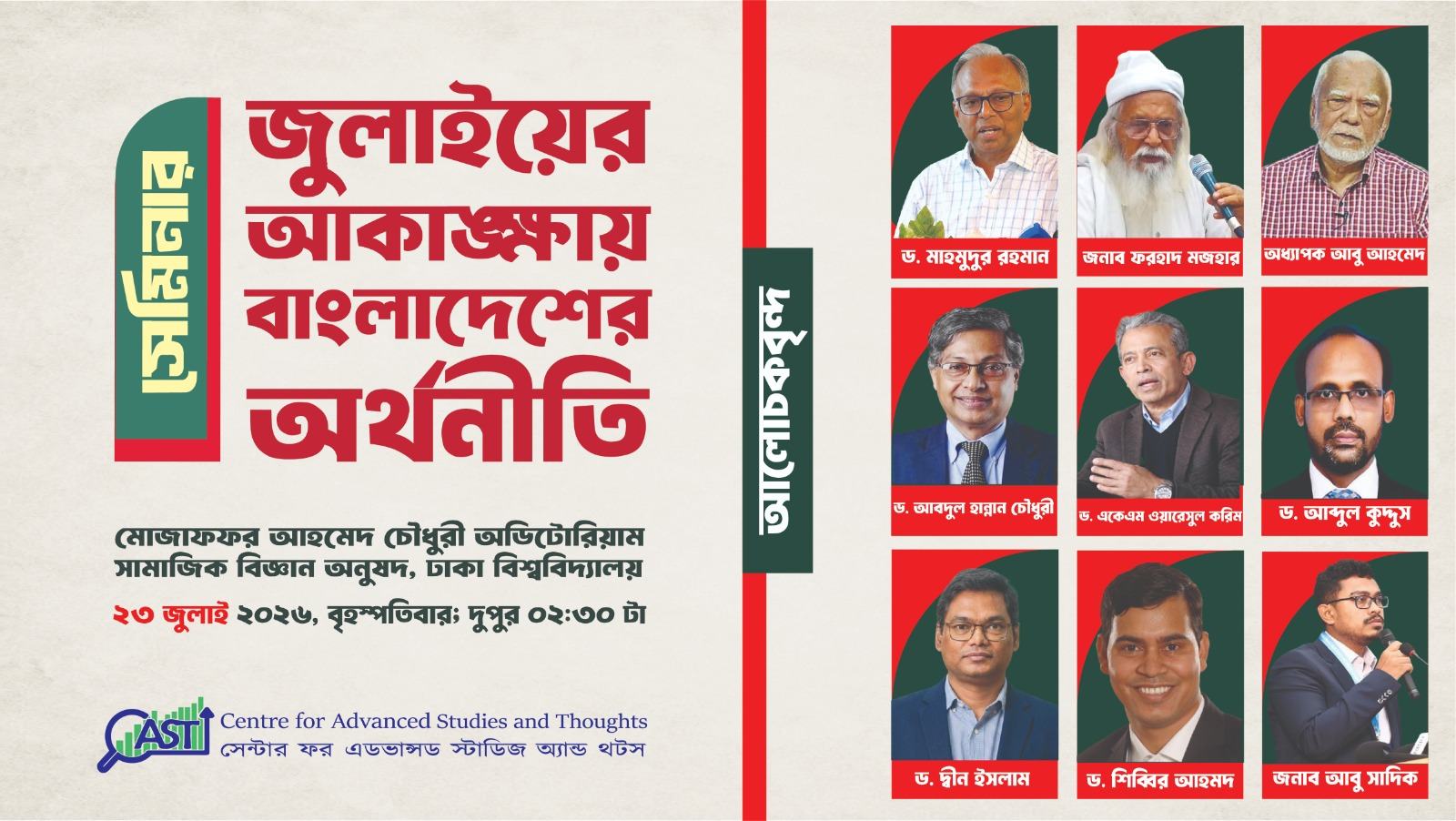
Did the July Uprising embody an economic vision alongside its political and social demands? If so, what would a just, inclusive, and sustainable economic order look like in the context of post-July Bangladesh? Has the call for justice that emerged through the uprising—extending across governance, public institutions, and everyday civic life—translated into meaningful progress in the country's economic policies and institutions? Or do structural inequalities, governance challenges, and uneven development continue to hinder the realization of those aspirations?
These questions lie at the heart of our seminar, "জুলাইয়ের আকাঙ্ক্ষায় বাংলাদেশের অর্থনীতি (Bangladesh's Economy in the Aspirations of the July 2024 Revolution)." The discussion will critically examine the economic dimensions of the July movement by exploring how its broader demands for accountability, equity, and justice intersect with fiscal policy, employment, investment, social protection, inflation, governance, and long-term development. The seminar will also assess the opportunities and challenges facing Bangladesh as it seeks to build an economy that is not only resilient and competitive but also fair, transparent, and responsive to the needs of its citizens.
Bringing together academics, researchers, policy practitioners, students, and public intellectuals, the seminar aims to foster evidence-based dialogue on the future of Bangladesh's economy in light of the transformative aspirations articulated during July. By connecting the movement's ideals with contemporary economic realities, the discussion seeks to contribute to a deeper understanding of what an economically just Bangladesh could look like and what policy pathways may help achieve that vision.


